How Much Do Dropshippers Make? (2026 Income Guide)
How much do dropshippers make in 2026? Income ranges, profit margins by niche, a worked monthly example and what beginners can realistically expect.


Most beginner dropshippers make between nothing and about $2,000 a month in their first stretch, and a lot of them lose money while they learn. Sellers who find a few products that work and keep their costs tight move into the $2,000 to $10,000 range, and a small group scales well beyond that. Those numbers come from vendor data, not guarantees, and they mix up revenue and profit more often than they should. The better question is how much of each sale you keep, because that's the figure that decides your income.
This guide covers how much dropshippers make in 2026 by experience level, what a realistic profit margin looks like, how to think about a "dropshipping salary" when you don't have one, and what a beginner can honestly expect in year one. It also shows where each dollar of a sale goes, so you can run your own numbers before you spend on ads.
How much do dropshippers make?
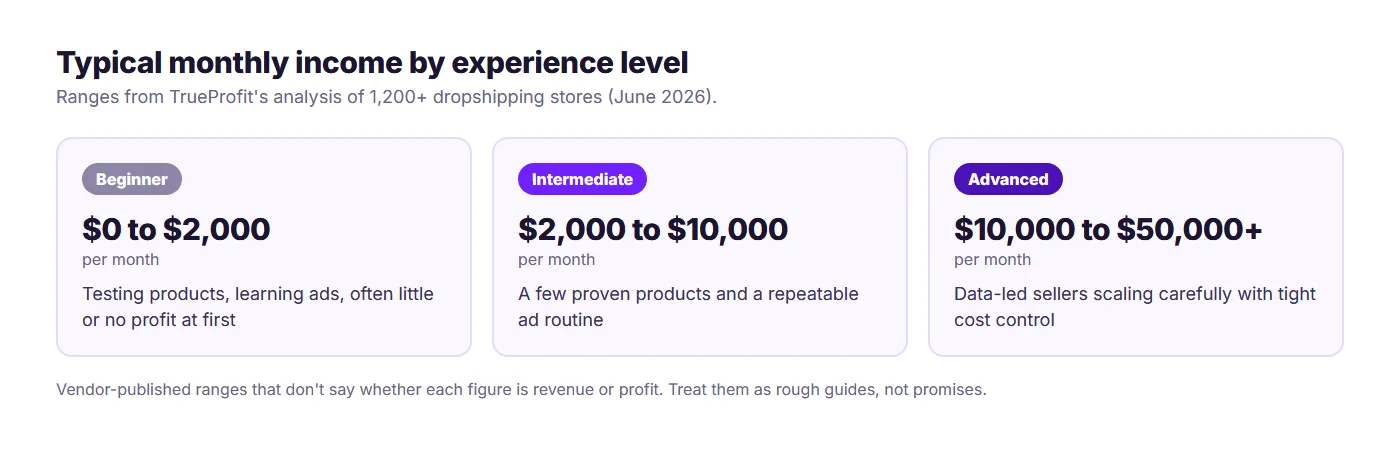
There's no average that means much, because the spread between sellers is huge. The most useful published breakdown is TrueProfit's analysis of 1,200+ dropshipping stores from June 2026, which puts monthly income in three bands.
| Stage | Typical monthly income | What it usually looks like |
|---|---|---|
| Beginner | $0 to $2,000 | Testing products, learning ads, often small or no profit |
| Intermediate | $2,000 to $10,000 | A few proven products and a repeatable ad routine |
| Advanced | $10,000 to $50,000+ | Data-led, scaling carefully, tight cost control |
TrueProfit also reports that most dropshippers earn roughly $20,000 to $120,000 a year, with a smaller experienced group reaching $120,000 to $600,000 or more. Two cautions apply. These are figures published by a profit-tracking software company, and the source doesn't make clear how much is revenue and how much is profit. Treat them as rough shape, and be wary of anyone who quotes a single "average dropshipper income" with confidence.
Revenue vs profit: the number that actually pays you
"I made $10,000 last month" can mean very different things. Here's how the terms differ:
- Revenue is everything customers paid you.
- Gross profit is revenue minus what you paid the supplier for products and shipping.
- Net profit is what's left after ads, payment fees, apps, refunds and every other cost. This is your real income, before tax.
Screenshots of Shopify dashboards usually show revenue. They don't show ad spend or refunds, which is why they're misleading. A store with $10,000 in monthly sales and a 12% net margin earns $1,200. The same store at 20% earns $2,000. At 30% it earns $3,000. Same sales, very different pay.
Where a $100 sale actually goes
Take a $100 order from a beginner store. The supplier takes a big share, the ad platform takes another, and card processing, tools and refunds nibble at what remains.
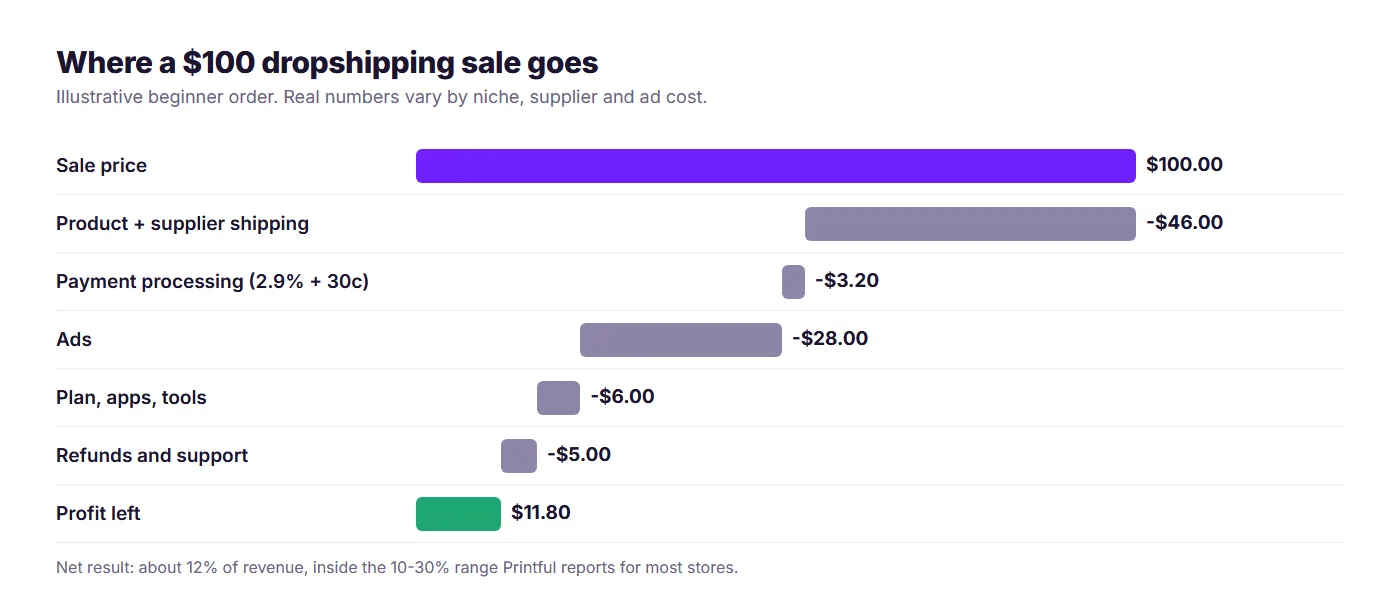
In this example, $46 goes to the supplier for the product and shipping, $3.20 to card processing (2.9% + $0.30), $28 to advertising, $6 to your store plan, apps and tools (spread across orders), and $5 to refunds and support time. That leaves $11.80, or about 12%. It's an illustration, not a statistic, but it matches the range Printful reports: most stores net 10% to 30%, and beginners typically sit under 15%.
Notice what moves the result most. Cut the ad cost from $28 to $20 and the profit jumps from $11.80 to $19.80, a 68% increase. Lift the price by $10 without losing sales and most of that extra $10 drops straight to profit. Small changes to ads and pricing matter more than almost anything else you can do.
Dropshipping profit margins by niche
Margins vary a lot by what you sell. Printful's 2026 analysis gives these rough ranges:
| Category | Typical net margin | Why |
|---|---|---|
| Fashion and apparel | 10% to 20% | Biggest by revenue, but crowded and return-heavy |
| Jewelry and accessories | 20% to 35% | Light to ship, high perceived value |
| Home and garden | 15% to 30% | Higher order values, less price-sensitive buyers |
| Print on demand | 20% to 40% (commonly reported) | Your own designs let you price above generic products |
Treat these as starting points. Your own supplier prices and ad costs decide where you land inside the range. If you want to choose a niche with margin in mind, see best dropshipping niches.
Dropshipping salary: why there isn't one and how to pay yourself
If you searched for a "dropshipping salary", the honest answer is that there isn't one. You're a business owner, not an employee. Nobody pays you a fixed amount. You pay yourself from what's left after costs, and in the early months that may be nothing.
A few ways to think about it:
- Treat profit as your pay. If the store nets $1,500 a month and you spend 25 hours a week on it (about 108 hours a month), you're earning roughly $14 an hour. That's the number to compare with a job.
- Leave money in the business. Early on, reinvest most profit into ads and stock-out buffers rather than withdrawing it.
- Set tax aside every month. In the US, self-employed people pay a 15.3% self-employment tax on net earnings, in addition to income tax.

The IRS explains the self-employment tax rate, and estimated tax payments are usually due quarterly if you expect to owe tax. Your situation depends on your country and state, so speak to an accountant. For sales tax and registration basics, see dropshipping taxes.
How much can a beginner make in the first year?
Here's a realistic frame, not a promise. The first one to three months are testing: you spend on samples, ads and tools, and most products won't work. Many beginners finish this phase with little or no profit. If a product does work, you scale it carefully, and the following months show whether the income is repeatable.
It helps to see what different outcomes need in volume. This table shows monthly net profit at two margins, and the orders per month you'd need at a $50 average order value.
| Monthly revenue | Orders at $50 each | Profit at 12% net | Profit at 20% net |
|---|---|---|---|
| $5,000 | 100 (about 3 a day) | $600 | $1,000 |
| $15,000 | 300 (about 10 a day) | $1,800 | $3,000 |
| $30,000 | 600 (about 20 a day) | $3,600 | $6,000 |
Even 10 orders a day is a real business with real support, returns and ad management behind it. And fixed costs don't wait: a Shopify Basic plan at $29/month plus an app like Spocket at $39.99/month is about $69 before you've spent a cent on ads. If you're modelling your own numbers, use the profit margin calculator or read dropshipping startup costs for the full cost list.
A worked example: one month in the life of a beginner store
Here's a full month for a store that has found a product that sells. It does 120 orders at a $50 average order value, so revenue is $6,000. The numbers are illustrative, but each line is built from the kinds of costs you'll actually pay.
| Line | Amount | Share of revenue |
|---|---|---|
| Revenue (120 orders at $50) | $6,000 | 100% |
| Products and supplier shipping | -$2,760 | 46% |
| Advertising | -$1,680 | 28% |
| Card processing (2.9% + $0.30 per order) | -$210 | 3.5% |
| Store plan, supplier app and tools | -$120 | 2% |
| Refunds and chargebacks | -$300 | 5% |
| Net profit | $930 | 15.5% |
That's $930 for a month of work, which is a decent outcome for a beginner and nowhere near a salary. Now see how fragile it is. If ad costs rise by 20% (plausible when competition picks up), advertising goes from $1,680 to $2,016 and net profit drops to $594. If refunds double to $600, profit falls to $630. Either bad break alone cuts profit by about a third, and together they leave $294. This is why experienced sellers watch costs weekly rather than monthly.
How to track what you really make
Most beginners overestimate their income because they only look at sales. Keep a simple weekly sheet with these columns: revenue, product and shipping cost, ad spend, fees, refunds, and net profit. Update it every Monday for the week before. After a month you'll know your real margin, your cost per order and which products carry the store.
Shopify's reports show sales and orders, but they won't show ad spend or true profit unless you add costs yourself, so use a spreadsheet or a profit-tracking app. Whatever you use, count every cost, including the small subscriptions and the time you spend on support. If a number is hard to find, it's usually the one that hurts.
Dropshipping vs a regular job: the hourly-rate test
If you're asking about a salary, you're really comparing dropshipping with a paycheck. Run the test honestly. Say a part-time job would pay you $18 an hour for 25 hours a week. That's roughly $1,950 a month ($18 x 108 hours). To match it from dropshipping, you'd need $1,950 of net profit for the same hours.
At a 15% net margin, that takes about $13,000 in monthly sales, which is around 260 orders at a $50 average order value, or close to nine orders every day. At a 25% margin it takes $7,800 in sales, or about 156 orders. The gap between those two figures is why margin work pays off so well. A store that gets from 15% to 25% needs 40% fewer orders to earn the same money.
Seen this way, the early months of a new store usually pay less than a job per hour, and that's normal. The trade is that a job's income is capped by your hours, while a store's income can grow without more hours if the products and ads keep working. Whether that trade suits you depends on how much risk, delay and uncertainty you can live with.
What decides how much you make
- Product margin. A product with a $12 supplier cost sold at $20 can't pay for ads. A common rule of thumb is pricing at two to three times your landed cost, then checking that against your real ad costs.
- Cost to get an order. Your ad spend per sale is usually the biggest cost. If it's higher than your gross profit per order, you lose money on every sale.
- Average order value. Bundles and add-ons spread ad cost over more profit.
- Shipping speed. Slow delivery drives "where is my order" emails, refunds and chargebacks. Faster suppliers cost more per item but can protect margin.
- Refund and chargeback rate. A few percentage points here can erase most of a beginner's profit.
- Repeat customers. Email and a good first experience bring buyers back at no ad cost.
- Time and consistency. The sellers who earn most test steadily, cut losers fast and keep records.
Why many dropshippers earn little
It's worth being direct about this, because the content that sells courses isn't. Common reasons beginners earn little or nothing:
- They pick products by what's trending, not by margin.
- They price from the supplier's suggestion instead of working backwards from ad costs.
- They run ads for a few days, see no sales and quit, or scale a lucky first sale too fast.
- They use slow suppliers, then lose money on refunds and chargebacks.
- They compare themselves to screenshots that show revenue rather than profit.
None of that is a reason not to try. It's a reason to start small, track every cost and decide in advance how much you're willing to lose while you learn. For a step-by-step launch, read how to start a Shopify dropshipping store, and if you're new to the model, what is dropshipping and how it works.
How to increase your dropshipping income
- Raise prices before cutting costs. Test $5 to $10 higher on products that sell. A small price rise is worth more than a similar cut in ad spend.
- Bundle. Offer a second item at a discount to raise the order value without paying for another click.
- Cut underperformers quickly. Set a rule in advance, such as stopping a product after a fixed spend with no profitable sales.
- Use faster, more reliable suppliers. Fewer delays mean fewer refunds and better reviews. Spocket focuses on US and EU suppliers, with shipping typically in 2 to 7 days, and plans start at $39.99/month. See trending products to see what's available.
- Build an email list. A buyer who returns costs you nothing to acquire.
- Improve your ad routine. Test one variable at a time. Dropshipping ads best practices covers how.
If you want to see which products have room for margin before you build anything, try the Spocket 7-day trial and compare supplier prices against what stores charge.
So, how much will you make?
Plan on little or nothing in your first few months, a modest profit if you find a product that works, and meaningful income only if you keep testing and keep costs under control. Work out your net margin before you spend on ads, track revenue and profit separately, and don't judge the model by anyone's screenshot.
When you're ready to start testing, start your 7-day Spocket trial and look at margins on real products first.
Start your dropshipping business today
Dropshipping Income FAQs
How much do dropshippers make a month?
It varies widely. TrueProfit's June 2026 analysis of 1,200+ stores puts most beginners at $0 to $2,000 a month, intermediate sellers at $2,000 to $10,000, and advanced sellers at $10,000 to $50,000 or more. The source doesn't clearly separate revenue from profit, so treat these as rough ranges rather than what you should expect to take home.
How much do beginner dropshippers make?
Most beginners make little or nothing in the first one to three months while they test products and learn ads. Published beginner ranges run from $0 to about $2,000 a month. Many sellers lose money at first, so start with a small test budget you can afford to lose, and track profit separately from sales.
What is a good profit margin for dropshipping?
Printful reports that most dropshipping stores net between 10% and 30% after product costs, shipping, fees and ads, with beginners typically under 15%. TrueProfit treats 15% to 25% net as a strong benchmark. Anything under about 10% leaves little room for refunds, price changes or a bad week of ad results.
Is there a dropshipping salary?
No. Dropshippers are self-employed, so nobody pays a fixed salary. You pay yourself from net profit after ads, fees, tools and refunds, and in the early months that may be zero. A useful check is your hourly rate: divide monthly net profit by the hours you work, then compare that with a normal job.
Can you make a full-time income from dropshipping?
Some people do, but it usually takes months of testing and steady work first. Earning $3,000 a month at a 20% net margin needs about $15,000 in monthly sales, which is roughly 300 orders at a $50 average order value. Many people keep a job while they build, and only go full time once profit has been steady for several months.
Do dropshippers pay taxes on their income?
Yes. Profit is taxable income, and in the US self-employed people pay a 15.3% self-employment tax on net earnings in addition to income tax. You may also need to collect sales tax on orders. Rules depend on where you live and where you sell, so set money aside every month and check with a qualified accountant.
How long does it take to make money dropshipping?
Most sellers need at least a few weeks to launch and several more months of testing before income is steady. First profit often arrives within the first few months for those who find a product that works, but some never do. Speed depends on product margin, ad skill, supplier quality and how quickly you stop products that aren't working.
Is dropshipping passive income?
Not in the early years. You'll spend time testing products, running ads, answering customers and fixing supplier problems. Automation and apps can reduce the daily workload, such as sending orders to suppliers, but someone still has to manage marketing, support and cash flow. Treat it as running a small business rather than a set-and-forget income stream.


Launch your dropshipping business now!
Start free trial


Related blogs
Dropshipping Supplier Directory: Where to Find Vetted Suppliers
Browse our directory of vetted dropshipping suppliers across the US and EU, complete with niches, shipping speed, and pricing. Start your free trial today.

How to Negotiate With Dropshipping Suppliers: 9 Tactics That Actually Work
Learn how to negotiate with dropshipping suppliers on price, MOQs, and payment terms. Proven tactics and email scripts to boost your margins. Try Spocket free.

Is AliExpress Legit? A Safety Check for Buyers and Dropshippers
Is AliExpress legit? Yes, but sellers vary. See how Buyer Protection works, what the EU's 2026 fine means, customs costs, and whether it's safe for dropshipping.