Market Research Methods and Competitive Analysis: The Complete Guide for Smarter Business Growth
Learn the most effective market research methods and competitive analysis techniques to grow your business. Includes practical steps, frameworks, and insights for ecommerce brands.
.avif)

Every successful business is built on one foundation: understanding the market. Whether you're launching a new online store, validating a product idea, entering a new industry, or scaling your brand, your decisions must be guided by accurate data—not assumptions.
This is where market research and competitive analysis become essential. Market research helps you understand your customers’ needs, motivations, buying behavior, and expectations. Competitive analysis reveals how your rivals operate, where they excel, and where gaps exist in the market. Together, these tools allow you to develop stronger strategies, improve product selection, price competitively, and position your brand effectively.
For ecommerce entrepreneurs—especially those building stores with fast-shipping US/EU suppliers through Spocket—market research is not optional. It determines what products to sell, which audiences to target, how to brand your store, and how to stand out in a crowded market.
This comprehensive guide breaks down everything you need to know about market research and competitive analysis, including methods, frameworks, tools, examples, and practical steps you can implement immediately.
What Is Market Research?
Market research is the process of collecting and analyzing information about your customers, competitors, and market environment. It reveals what people want, how they think, and why they buy, enabling you to make more accurate business decisions.
Why Market Research Matters
- It validates product ideas before investing money
- Helps you understand customer pain points
- Reduces business risks
- Identifies new opportunities
- Guides pricing, branding, and marketing strategies
- Gives you a competitive advantage
Whether you're building a side-hustle or scaling a full ecommerce brand, market research ensures your decisions are rooted in evidence rather than assumptions.
Types of Market Research
Modern market research falls into several categories. Each method offers different insights and plays a role in developing a complete understanding of your audience and competition.
1. Primary Market Research
Primary research involves collecting new, firsthand data directly from your target audience. It provides the most accurate, relevant insights because you gather the information yourself.
Examples of Primary Research
- Surveys
- Interviews
- Focus groups
- Product tests
- Customer feedback forms
What Primary Research Helps You Discover
- Why customers buy certain products
- Their motivations, frustrations, and expectations
- How much they are willing to pay
- Which features matter most
- What alternatives they consider
Primary research is incredibly powerful for ecommerce store owners using Spocket because it helps validate which products your target audience is genuinely interested in before you stock your store.
2. Secondary Market Research
Secondary research involves analyzing existing data that others have already collected.
Examples of Secondary Sources
- Industry reports
- Government data
- Sales statistics
- Competitor websites
- Market trend articles
- Academic papers
This type of research is useful for understanding industry-wide trends, market size, and demographic information. It complements primary research by helping you see the bigger picture.
3. Qualitative Research
Qualitative research focuses on exploring motivations, emotions, and user behavior.
Methods Include
- Open-ended interviews
- Focus groups
- Observational studies
- Social media discussions
- Review mining
What It Helps You Understand
- Customer pain points
- Desires and preferences
- Buying behavior
- Emotional triggers
Qualitative research answers the question: Why do customers behave the way they do?
4. Quantitative Research
Quantitative research focuses on numerical data to identify measurable trends.
Examples
- Large-scale surveys
- Website analytics
- Conversion metrics
- Sales data
- Market share statistics
Key Benefits
- Helps validate assumptions
- Shows statistically relevant patterns
- Provides measurable insights
Together, qualitative and quantitative research create a well-rounded understanding of your market.
Essential Market Research Methods
Below are the most effective market research methods recommended by top business guides and industry experts.
1. Surveys
Surveys are one of the most scalable and efficient ways to collect customer data. They can be used to measure satisfaction, demand, price sensitivity, and customer behavior.
Best Practices for Surveys
- Keep questions concise
- Avoid leading questions
- Use a mix of multiple-choice and open-ended questions
- Target a specific audience
Use surveys before launching new products in your Spocket store to avoid stocking items that don’t sell.
2. Interviews
Interviews allow you to explore customer motivations in detail. They reveal deeper insights that surveys cannot capture.
What to Ask
- What challenges do you face when buying products in this category?
- What do you wish existed that doesn’t?
- What makes you choose one brand over another?
Interviews are incredibly valuable for understanding emotional triggers and purchasing behavior.
3. Focus Groups
Focus groups bring together a small group of people to discuss your product, brand, or industry.
Benefits
- Real-time reactions
- Honest feedback
- Diverse opinions
This method is especially helpful during product development or branding decisions.
4. Observational Research
This involves studying how customers behave in real or digital environments.
Examples
- Watching user interactions on your website
- Analyzing how shoppers navigate ecommerce stores
- Monitoring customer behavior on social media
Observational research reveals how people behave vs. what they say they do.
5. Social Listening
Social listening analyzes public conversations on social media to understand customer sentiment.
What It Reveals
- Popular trends
- Customer complaints
- Frequently mentioned competitors
- Product preferences
It’s an excellent tool for identifying trending products to sell in your Spocket store.
6. Keyword Research
Keyword research shows what people actively search for online. This is one of the most powerful tools for ecommerce entrepreneurs.
What It Helps You Understand
- Search demand
- Popular product categories
- Customer intent
- Market size
Tools help you identify which niches have strong demand and low competition.
7. Review Mining
Review mining involves reading customer reviews on marketplaces, competitor stores, and social platforms.
Why It's Valuable
- Reveals common complaints
- Highlights unmet needs
- Shows what features people care about
- Helps you identify product improvements
Review mining lets you position your products more effectively than competitors.
What Is Competitive Analysis?
Competitive analysis is the process of identifying and evaluating your competitors to understand their strengths, weaknesses, strategies, and market positioning.
Why Competitive Analysis Matters
- Helps you differentiate your brand
- Reveals gaps in the market
- Improves your product selection
- Guides pricing decisions
- Strengthens marketing strategies
- Helps predict industry shifts
For ecommerce entrepreneurs, competitive analysis is critical to choosing the right products and pricing structure—especially when using Spocket suppliers for premium goods.
Types of Competitors You Should Analyze
To understand your competitive landscape fully, you must look beyond businesses that simply sell the same products. Competitors exist on multiple levels, and each type influences customer decisions differently. A strong competitive analysis breaks these groups into three categories:
1. Direct Competitors
Direct competitors are businesses that sell the same or very similar products to the same target audience. They compete with you head-on in product selection, price, branding, and customer experience.
For example, if you sell women’s activewear, any online store offering the same styles and targeting the same demographic is a direct competitor.
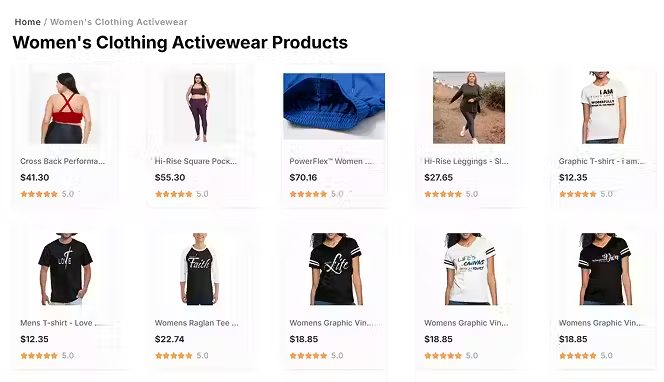
These businesses are the most important to analyze because they influence your pricing, product quality, and positioning strategy.
2. Indirect Competitors
Indirect competitors offer products or solutions that are different from yours but still satisfy the same need or desire. For instance, a customer wanting to improve physical fitness might choose activewear (your product), but they might also buy a fitness app subscription, resistance bands, or home gym equipment from another brand. These competitors broaden your view of the market and help you understand what alternative choices customers are considering.
3. Replacement Competitors
Replacement competitors provide a completely different product or method that solves the same problem in a new or unconventional way. For example, a luxury handbag brand competes not only with other handbag brands but also with experiences, gadgets, or high-end accessories—anything customers may buy instead of your product. These competitors remind you that people have limited budgets, and sometimes your biggest competition isn’t another product—but another category entirely.
Essential Competitive Analysis Frameworks
Competitive analysis becomes far more effective when you use structured frameworks to evaluate your rivals systematically. These frameworks help you organize information, compare competitors objectively, and identify strategic opportunities for your own business. By applying the models below, you can uncover gaps in the market, understand competitive strengths and weaknesses, and position your products more effectively—especially in fast-moving industries like ecommerce.
1. SWOT Analysis
A classic framework that highlights:
- Strengths
- Weaknesses
- Opportunities
- Threats
Use this to evaluate both your business and your competitors.
2. Porter’s Five Forces
This framework evaluates your industry's competitiveness by analyzing:
- Competitive rivalry
- Threat of substitutes
- Threat of new entrants
- Supplier power
- Customer power
It helps you understand whether your market is profitable and sustainable.
3. Competitor Feature Matrix
Create a matrix comparing:
- Price
- Product range
- Shipping speed
- Customer reviews
- Branding
- Website experience
This reveals where you can outperform your competitors.
4. Market Positioning Map
A visual map that shows where each competitor stands in terms of:
- Price vs. quality
- Basic vs. premium
- Niche vs. broad
This helps you position your own brand effectively.
How to Conduct Competitive Analysis Step-by-Step
A powerful competitive analysis doesn’t happen by guesswork — it follows a structured process. By breaking it into clear steps, you can move from vague impressions about your competitors to concrete, actionable insights. The framework below walks you through identifying who your competitors are, analyzing what they offer, evaluating how they position themselves, and uncovering where your business can gain an advantage in the market.
Step 1: Identify Your Top Competitors
Search your product keywords, explore marketplaces, and use competitor listing tools to identify who ranks highest.
Step 2: Analyze Their Product Offerings
Look at product range, quality, shipping promises, and customer reviews.
Step 3: Evaluate Their Pricing
Determine how they price their products compared to market standards.
Step 4: Assess Their Branding and Positioning
Study how competitors present themselves:
- Brand colors
- Messaging
- Value proposition
Step 5: Analyze Their Marketing Channels
Look at:
- Social media
- Email campaigns
- Ads
- SEO strategies
Step 6: Identify Their Strengths and Weaknesses
Use SWOT or your feature matrix to map this clearly.
Step 7: Find Market Gaps
This is where you can outperform them with:
- Better product quality
- Faster shipping
- Stronger branding
- More competitive pricing
How Market Research Helps Ecommerce Stores Succeed
For ecommerce businesses, market research influences every part of your strategy:
1. Product Selection
You choose products based on real demand rather than assumptions. You can take help of DropshipTool to find winning products in the market.
2. Pricing Strategy
You understand what customers are willing to pay.
3. Branding
You create a brand identity that resonates with your audience.
4. Marketing
You know which channels your audience uses and what messaging they respond to.
5. Customer Retention
You understand how to create better experiences that build loyalty.
This is why Spocket sellers often perform better—they combine quality suppliers with research-driven decision-making.
Common Mistakes to Avoid in Market Research
Even well-intentioned businesses can make critical errors when conducting market research. These mistakes often lead to inaccurate conclusions, poor decisions, and missed opportunities. Understanding what to avoid will help you gather stronger insights and make better strategic choices.
1. Relying on Assumptions
One of the biggest pitfalls is assuming you already know what customers want. Personal opinions, intuition, or past experiences cannot replace real data. Market preferences change, and customers may value features or benefits you did not expect. Effective research is built on evidence, not assumptions.
2. Using Small or Unreliable Sample Sizes
Data is only useful when it represents a meaningful portion of your target audience. Relying on a handful of responses or feedback from a narrow group can lead to misleading conclusions. Larger, diverse, and well-targeted samples produce far more accurate insights.
3. Ignoring Competitors
Some businesses focus only on their products and customers while overlooking competitors entirely. This is a major mistake. Competitors influence pricing, demand, marketing strategies, and customer expectations. Ignoring them can leave you vulnerable and unaware of emerging threats.
4. Focusing Only on Trends
Trends attract attention, but they are not always reliable indicators of long-term demand. Jumping into a trending product without validating its staying power can result in wasted time and inventory. Research should balance trend analysis with long-term market stability.
5. Not Updating Research Regularly
Markets evolve quickly. Customer behavior shifts, new competitors emerge, and technology changes. Relying on outdated research can lead to strategies that no longer work. Making market research an ongoing practice — not a one-time task — ensures you stay competitive and informed.
Final Verdict: Research Fuels Smarter Decisions
Market research and competitive analysis are essential tools for building a strong, profitable business. They help you understand your customers deeply, choose the right products, and outsmart your competition. Research-driven businesses make better decisions, reduce risk, and adapt faster to market changes.
For ecommerce entrepreneurs, pairing strong research with high-quality suppliers is a winning formula. That’s where Spocket becomes invaluable — helping you access premium products, fast shipping, and reliable fulfillment, all while using research to guide your strategy.
Whether you're launching your first store or optimizing an existing one, grounding your decisions in solid research will set you apart and accelerate your success.
Start your dropshipping business today
FAQs about Market Research and Competitive Analysis
What is the main purpose of market research?
The primary purpose of market research is to understand your customers, industry conditions, and market demand. It helps businesses make informed decisions about product selection, pricing, branding, marketing, and expansion. By collecting accurate data, you reduce risk and increase your chances of launching products that perform well.
How often should businesses conduct competitive analysis?
Competitive analysis should be conducted regularly — at least every quarter. Markets change quickly, new competitors enter, customer preferences evolve, and pricing shifts. Frequent analysis helps you stay ahead, identify new opportunities, and adjust your strategy before competitors do.
What is the difference between primary and secondary research?
Primary research involves gathering new data directly from your target audience through surveys, interviews, or focus groups. Secondary research uses existing data from external sources such as reports, articles, industry studies, and government statistics. Both are essential, and combining them provides a complete understanding of your market.
Why is analyzing indirect and replacement competitors important?
Direct competitors aren’t the only ones influencing customer decisions. Indirect competitors offer similar solutions, while replacement competitors offer alternative ways to solve the same problem. Analyzing all three helps you understand the full spectrum of choices customers have, allowing you to position your business more effectively.
How does market research benefit ecommerce businesses?
Market research helps ecommerce brands identify high-demand products, understand buyer expectations, choose the right price points, and refine marketing strategies. When paired with reliable supplier tools like Spocket, research ensures that store owners select products customers genuinely want — improving conversions, reducing returns, and increasing long-term profitability.


Launch your dropshipping business now!
Start free trial


Related blogs

Dripshipper Reviews: Is This Coffee Dropshipping Platform Worth It?
Read this detailed Dripshipper review covering features, pros, cons, pricing, customer feedback, profitability, and better dropshipping alternatives.


Is BigBuy Legit? Honest Review for Dropshipping Businesses
Find out if BigBuy is a reliable dropshipping supplier, including its features, pros, cons, pricing concerns, reviews, and alternatives for ecommerce sellers.

What is Micromarketing and How to Use it Effectively
Learn what micromarketing is, how it works, its benefits, examples, and how ecommerce businesses can use it to target niche customers effectively.