How to Start an Ecommerce Business
Learn how to start an ecommerce business with the right niche, products, suppliers, store setup, marketing, and scaling strategies for long-term success.


Starting an ecommerce business can feel like a lot—products, suppliers, websites, payments, shipping, marketing, and the constant “am I doing this right?” voice in your head. The good news is you don’t need a huge budget or a perfect plan to begin. You need a clear model, a validated product idea, a store that looks trustworthy, and a launch plan you can execute.
This guide walks you through the full journey from idea to first sales, with practical steps, real-world considerations, and the kind of details most “ultimate guides” skip. Whether you’re building a serious brand or testing a side hustle that could become passive income later, the process is the same—start simple, validate early, and scale what works.
What Counts as an Ecommerce Business
Ecommerce is any business that sells products or services online, where the transaction happens digitally. That can mean a full Shopify store, a marketplace listing, a subscription box, or a digital product checkout page. Understanding what “counts” matters because your business model determines everything that comes next—your costs, marketing channels, risk level, and how quickly you can start.
Common ecommerce types (B2C, B2B, DTC, marketplace, subscription)
- B2C (Business to Consumer) is what most people think of: selling directly to customers through your store.
- DTC (Direct to Consumer) is a modern version of B2C, usually with a stronger brand focus and higher margins.
- B2B (Business to Business) sells to other businesses. It’s often slower to grow, but order values can be larger and more predictable.
- Marketplace selling means listing on platforms like Amazon, Etsy, or eBay. It’s faster to start, but you rely on the platform.
- Subscription ecommerce delivers recurring products monthly or quarterly. It can stabilize revenue, but churn and logistics matter more.
Ecommerce business models
Your “type” is who you sell to. Your “model” is how you source and fulfill.
- Dropshipping: You sell a product, then a supplier ships it to your customer. Lower upfront cost, but margins and shipping quality matter.
- Wholesale/reselling: You buy inventory in bulk and resell. Better margins, but higher upfront investment and storage.
- Private label: You source a product and brand it as your own. Higher control and long-term brand value, but more complexity.
- Print-on-demand: Custom apparel and accessories printed after the order. Great for creators, but product quality and delivery times vary.
- Digital products: Templates, courses, ebooks, software. High margins and instant delivery, but you need demand and strong marketing.
Which model is easiest to start (and why)
If your goal is to start fast with minimal risk, dropshipping and print-on-demand are often the simplest. They avoid upfront inventory costs and let you test demand quickly. That said, “easy to start” doesn’t mean “easy to win.” Your edge comes from choosing the right product, building trust, and delivering a smooth customer experience—especially around shipping, returns, and support.
Steps to Start an Ecommerce Business in 2026
Starting an ecommerce business in 2026 isn’t just about putting products online—it’s about choosing the right model, validating demand early, and building a store that customers trust from the first click. With smarter tools, faster fulfillment options, and higher customer expectations, the steps matter more than ever. The guide below breaks down each stage clearly, so you can move from idea to launch with confidence and avoid the mistakes that stop most new ecommerce businesses from growing.
1. Choose a Profitable Niche and a Real Customer Problem
Most ecommerce businesses don’t fail because of the platform they choose or the ad campaign they run. They fail because the foundation is weak. The niche is too broad, the product looks like everything else online, or the business doesn’t give customers a strong reason to buy from them specifically.
A profitable niche isn’t just “beauty” or “fitness” or “home decor.” It’s the overlap between three things: who you serve, what you sell, and why it matters to that customer. When you get that intersection right, everything becomes easier—product selection, content, pricing, marketing, and even retention. When you get it wrong, you’ll constantly feel like you’re pushing a boulder uphill.
The sections below break this down into practical steps you can actually follow, without guesswork or vague advice.
2. A Simple Niche Filter Demand Margin Repeat Buys Shipping Ease
Before you commit to a niche, run it through a filter that forces clarity. This is the easiest way to avoid wasting weeks building a store around an idea that can’t scale.
Demand
Demand means people are already searching for it or buying it consistently. The goal isn’t to invent a new market from scratch. It’s to enter a market where people already spend money and then carve out a smarter position within it.
A strong demand signal looks like this:
- You see similar products selling across multiple stores and marketplaces
- People ask questions about the product in forums or comment sections
- Search results show many product pages, not just blog posts
A weak demand signal looks like this:
- Only a few sellers exist and none have real reviews
- People search for the topic but not for products
- Interest spikes for a week then disappears
Demand protects you from building in isolation. It’s proof that buyers exist.
Margin
Margin is what you keep after all costs. Many beginners focus only on the product price and ignore the real expenses that affect profitability. You need margin to cover:
- Product cost
- Shipping cost
- Payment processing fees
- Platform and app fees
- Refunds or replacements
- Customer acquisition costs if you run ads
If you can’t make enough per order, you won’t be able to scale marketing. That’s why a product that “sells” but doesn’t “profit” is dangerous. It creates the illusion of growth while quietly draining your budget.
A healthy margin gives you room to test creatives, work with creators, and handle inevitable customer issues without panic.
Repeat Buys
Repeat buys make ecommerce easier because they reduce dependence on constant new customer acquisition. If you sell a product that people purchase multiple times, you get more lifetime value from each buyer. Repeat-buy potential is strong when:
- The product is consumable or needs refills
- It naturally leads to accessories or add-ons
- Customers buy it as gifts more than once
Repeat-buy potential is weaker when:
- It’s a one-time purchase and rarely replaced
- It’s highly seasonal
- It’s a major investment item
Even if your niche isn’t naturally repeat-based, you can create repeat behavior by adding bundles, complementary products, and post-purchase offers. But starting with a repeat-friendly niche gives you an advantage.
Shipping Ease
Shipping is where ecommerce gets real. Lightweight, durable products are easier because they:
- Cost less to ship
- Break less often
- Get returned less frequently
- Create fewer support tickets
Shipping becomes harder when products are:
- Fragile
- Size-sensitive like shoes or fitted clothing
- Complex to assemble or use
- Likely to arrive damaged
That doesn’t mean you can’t succeed with those categories. It just means you need stronger operations, clearer expectations, and better customer support.
If you want to start quickly and reduce risk, prioritize products that ship well.
3. How to Spot Demand Fast Google Autocomplete Trends Marketplaces
Once you have a shortlist of niches, the next step is to confirm demand quickly. You are not looking for perfect data. You are looking for clear signals that people actively want the product and are willing to buy it online.
Google Autocomplete
Google autocomplete is one of the fastest ways to understand what real people search for. Try typing phrases like:
- “best ____ for”
- “buy ____”
- “____ review”
- “____ vs ____”
- “____ price”
If autocomplete suggests product-focused phrases, that’s a positive signal. It shows the niche has active search intent and people are exploring purchase decisions.
If autocomplete mostly suggests informational content, you might need:
- A stronger educational funnel
- A more product-driven niche
- Better product positioning around a specific problem
Autocomplete is simple, but it reflects real behavior at scale.
Google Trends
Google Trends helps you avoid two traps: dead niches and short-lived hype. Look for:
- Steady interest over time
- Consistent seasonal patterns you can plan around
- Growth that isn’t just a sudden spike
Be careful with:
- Sharp spikes followed by a drop to zero
- Trends that are tied to one viral moment
- Products that depend entirely on one platform’s algorithm
Trends works best when you compare multiple keywords within the same niche. That helps you identify which angle has stronger long-term potential.
Marketplaces Amazon Etsy TikTok Shop
Marketplaces are a live window into what people are buying right now. They also show what kind of product presentation converts. Use marketplaces to:
- Spot winning product categories
- Look for products with strong review volume
- See how sellers position benefits and use cases
- Identify common complaints that you can solve
Amazon best sellers can show scale. Etsy can show creative niches and gift-focused trends. TikTok Shop can show impulse-buy behavior and viral product formats.
The goal is not to copy what’s trending blindly. The goal is to identify demand so you can serve better.
4. Competitor Reality Check What to Copy vs What to Differentiate
Competition is not the enemy. Competition is proof. It tells you people already buy in this category.
Your job is to understand:
- What competitors do well
- Where they are weak
- How you can offer something meaningfully different
What to Copy
Copying doesn’t mean stealing branding. It means learning the baseline expectations customers already have. You should match competitors on:
- Clear product photos
- Benefit-driven product descriptions
- Trust signals like policies and contact info
- Transparent shipping and delivery timelines
- Fast and simple checkout experience
If your store looks less credible than competitors, you lose before the product even matters.
What to Differentiate
Differentiation is what gives customers a reason to choose you. Strong differentiation often comes from:
- Better targeting for a specific audience
- Bundles that solve a full problem instead of one part of it
- Faster shipping options and clearer delivery promises
- Better brand story and customer support
- Higher perceived value through content, education, or product experience
A simple test is this: If you can’t explain your differentiation in one sentence, your niche may be too generic. Your differentiator becomes the core of your homepage copy, ads, and content. Without it, you’ll compete only on price, which is the hardest way to win.
5. Validate Your Product Idea Before You Spend Money
Validation protects your time, budget, and momentum. You don’t need perfect market research. You need enough proof that people want what you’re selling at a price that leaves you profit after costs.
The best validation combines:
- Search intent
- Competitor proof
- Unit economics
- Supplier reliability
When these align, your launch becomes far more predictable.
6. Validate Demand With Search Intent Keywords That Signal Purchase
Not all traffic is valuable. You want people who are close to buying. Buyer-intent keywords usually include:
- “buy”
- “best”
- “review”
- “vs”
- “coupon”
- “shipping” or “delivery time”
- “near me” for local delivery models
These phrases signal that a shopper is comparing options, looking for proof, or trying to reduce risk before purchasing.
If your niche only attracts informational searches like “what is ____,” you can still win, but you’ll need:
- Strong educational content that leads into product pages
- A longer funnel using email and retargeting
- Better conversion assets like guides and comparisons
For most beginners, it’s easier to start with niches that already show commercial intent.
7. Validate Price and Margin
This is the part many people skip, then regret later. Before committing to a product, calculate:
- Product cost
- Shipping cost to customer
- Payment processing fees
- Platform and app fees
- Expected refund or return rate
Your margin must support marketing. If you plan to run ads later, thin margins will trap you. Even if you’re starting organic, you still need profit room to handle refunds and support.
A product that sells but doesn’t profit forces you to work harder for less reward. That’s how businesses burn out quickly.
Pricing also affects perception. If your product is priced too low, customers may assume it’s low quality. If it’s priced too high without proof, customers hesitate. Validation helps you find a believable price point.
8. Validate Supply Stability, Lead Times, MOQ Defect Rates
Even in dropshipping, supply stability matters. Customers don’t care how your supply chain works. They care whether the order arrives. Ask suppliers or evaluate listings based on:
- How fast they can ship consistently
- Whether inventory frequently goes out of stock
- Their defect rate and replacement policy
- Whether tracking updates are reliable
Stable supply reduces:
- Refund requests
- Chargebacks
- Negative reviews
- Support ticket volume
That stability becomes a competitive advantage, especially in categories where customers expect speed.
9. Minimum Validation Scorecard Quick Checklist
Before you launch, you want to check most of these boxes:
- People are actively searching or buying similar products
- Your product has room for clear differentiation
- Shipping timelines are realistic and easy to communicate
- Margins can support marketing and refunds
- Supplier reliability looks consistent
If you cannot check most of these, pivot early. Pivoting at this stage saves you money and time. It is smart iteration, not failure.
10. Pick Your Supply Strategy and Fulfillment Plan
This is where ecommerce becomes “real.” Customers don’t remember your niche research. They remember whether their order arrived and whether you handled problems professionally.
Fulfillment is your reputation plan.
Supplier Options Local vs Global and What to Prioritize
Local suppliers can offer faster shipping and easier returns, but product costs may be higher. Global suppliers may offer a wider catalog and lower product costs, but shipping speed and consistency can vary.
Regardless of location, prioritize:
- Consistent delivery windows
- Tracking accuracy
- Clear replacement and refund workflows
- Product quality and packaging standards
These factors influence your review rating more than your product features.
Shipping Expectations by Region and How to Set Them On Site
Your shipping policy should be transparent and calm. Overpromising creates refunds and bad reviews. A strong shipping setup includes:
- A realistic delivery range
- A clear separation between processing time and transit time
- Tracking expectations
- A simple next step if delayed
Customers don’t mind waiting as much as they mind uncertainty. Clarity reduces anxiety and support requests.
Returns Replacements and Support Workflows Simple SOP
A predictable process keeps your business stable even when problems happen. Use a simple support SOP:
- Acknowledge issues within 24 hours
- Ask for photo or video only when needed
- Offer a clear next step refund replacement or store credit.
- Close the loop with tracking updates or confirmations
This reduces stress for you and builds trust with customers, even when something goes wrong.
If you are building a dropshipping store and want more control over the customer experience, Spocket can be useful for sourcing products with faster shipping options in the US and EU. That matters because delivery time is one of the biggest reasons customers request refunds or lose trust in a new store.
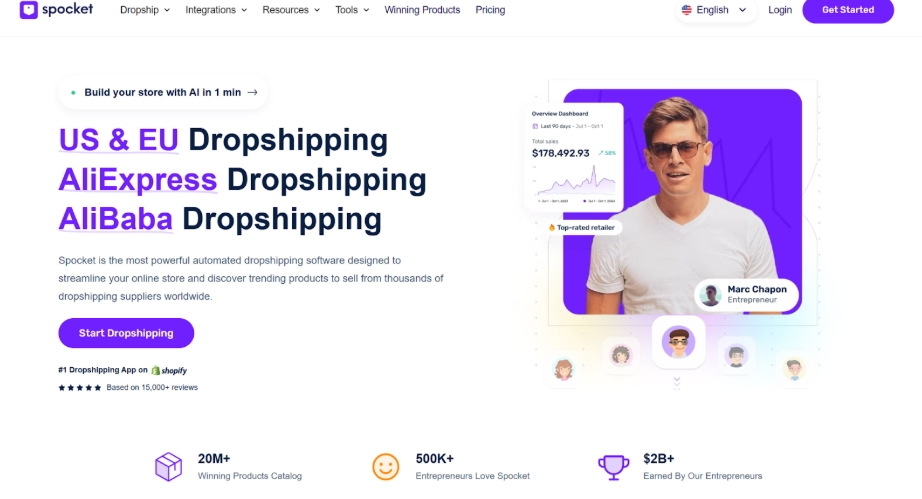
The key is to use Spocket strategically. Choose products based on demand and margins first, then use sourcing to strengthen customer experience. It should support validation, not replace it.
11. Track What Matters and Scale
Scaling is not doing more. It is doing more of what works without breaking quality. If you scale traffic without fixing conversion, you lose money faster. If you scale orders without solid operations, you burn out.
12. KPIs That Matter
Track a small set of metrics that protect profitability:
- Conversion rate: are visitors buying
- Average order value: are they buying enough per order
- Customer acquisition cost: what does it cost to acquire a customer
- Contribution margin: what is left after variable costs
These metrics tell you whether your store is sustainable. Vanity metrics like likes and pageviews are not enough.
13. When to Add New Products vs New Channels
Add new products when:
- Your store converts well
- Customers ask for related items
- Bundles can increase order value
Add new channels when:
- One channel is stable and repeatable
- Your offer is clear
- Your fulfillment can handle growth
If everything feels unstable, simplify. Stability comes before scale.
14. Scaling Fulfillment 3PL Triggers and Warning Signs
Consider a 3PL or more structured fulfillment when:
- Packing and support take too much time
- Shipping delays hurt reviews
- You need faster delivery options
- Order volume becomes consistent
The warning sign isn’t growth. Its quality slipping. If customer experience declines, scaling becomes expensive and stressful.
Conclusion
Starting an ecommerce business is a lot easier when you treat it like a sequence instead of a scramble. Choose a niche with real demand, validate your product idea with intent and margins, build a trustworthy store, and launch with a plan that lets you learn quickly without wasting money.
Once the foundation is stable, growth becomes a process—improve conversion, improve retention, and scale the channels that work. If you’re building with dropshipping, using tools like Spocket to source reliable products and improve shipping expectations can make the whole experience smoother for customers and easier for you to manage.
Start your dropshipping business today
FAQs About Starting an Ecommerce Business
How much does it cost to start an ecommerce business?
It depends on your model. Dropshipping and print-on-demand can start with a low upfront budget because you don’t buy inventory. If you’re buying stock, costs rise quickly due to product purchase, storage, and packaging. Your ongoing costs typically include platform fees, apps, domains, and marketing.
Can I start an ecommerce business with no money?
You can start with very little money, but “no money” is hard because you’ll still need basics like a domain, platform access, and some marketing effort. If the budget is tight, start with organic content, creator outreach, and a minimal product lineup. That’s the most realistic “make money without investment” approach for ecommerce—reduce costs, validate demand, then reinvest profits.
What’s the easiest ecommerce business model for beginners?
Dropshipping and print-on-demand are usually easiest to start because you avoid inventory risk. The trade-off is you must choose reliable suppliers and set clear expectations for shipping and returns. Many beginners succeed when they prioritize customer experience instead of chasing random trending products.
How long does it take to make your first sale?
Some stores make a sale within days. Others take weeks or months. The timeline depends on product-market fit, pricing, store trust, and marketing execution. If you want faster results, focus on a niche with existing demand, strong buyer intent keywords, and content that demonstrates the product clearly.
Is dropshipping still worth it?
It can be, if you treat it like a real business. The “worth it” part depends on product selection, supplier quality, and delivery experience. Customers are less patient with slow shipping than they used to be. That’s why sourcing choices and transparency matter more than ever.
Do I need a business license to start?
Requirements vary by country and region. Many people start small, then register formally as revenue grows. Still, you should understand what’s required where you operate, especially for taxes and payment processing. When in doubt, consult a local professional.


Launch your dropshipping business now!
Start free trial


Related blogs
Top WordPress eCommerce Themes for 2026
Explore the best WordPress eCommerce themes for 2026. Compare WooCommerce themes by speed, design, features, and dropshipping potential.


Saba Mohebpour Didn't Stop at Spocket: His New $50M Fund, ILA Capital, Is Buying Up Shopify and Amazon Apps
After building Spocket into a major ecommerce platform, Saba Mohebpour is launching ILA Capital with a $50M strategy to acquire Shopify and Amazon apps powering modern ecommerce.

Top Trendsi Alternatives for Fashion Dropshipping
Explore the best Trendsi alternatives for fashion dropshipping, fast shipping, branding, Shopify integration, and reliable suppliers.