Why Dropshipping Stores Fail: Top 10 Reasons Why Stores Close
Learn the real dropshipping failure rate, the top reasons stores shut down, and practical fixes to build a resilient brand with stronger suppliers and systems.
.avif)

Dropshipping looks simple from the outside: pick products, build a store, run ads, profit. But when you zoom in, most stores don’t fail because the model is “dead”—they fail because the business fundamentals are shaky.
A dropshipping store is still a real business with the same boring-but-critical requirements as any other: unit economics, customer trust, supplier reliability, differentiated positioning, and repeatable acquisition. When one of those pillars cracks, the store doesn’t always crash overnight. It usually bleeds out slowly through refunds, chargebacks, rising ad costs, and low conversion rates—until the owner finally closes it down.
This guide breaks down the most common reasons stores fail—plus specific, practical fixes you can apply before you become another “I tried dropshipping and it didn’t work” story.
Dropshipping failure rates: what the numbers really mean
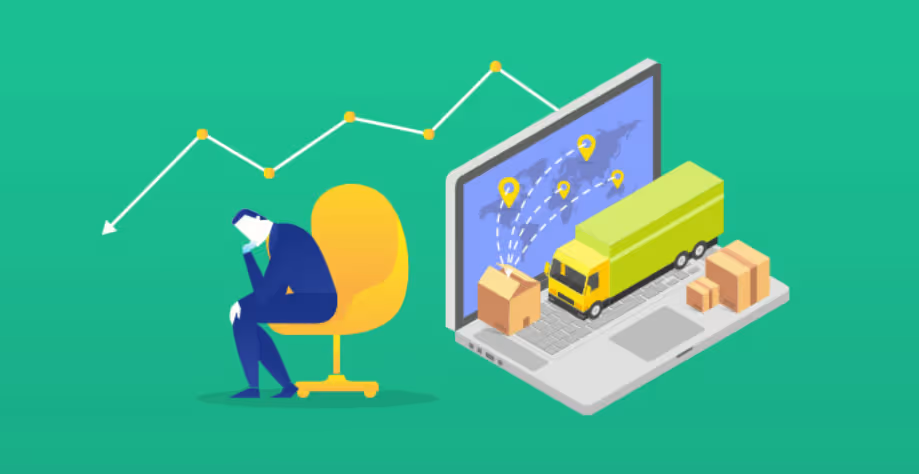
Dropshipping failure rates are hard to pin to one perfect number because “success” is subjective (profitability, salary replacement, long-term sustainability, etc.). Still, the available data and industry commentary paint a consistent picture: the average beginner is fighting uphill.
One widely cited benchmark is that nearly 90% of new dropshipping businesses don’t make it past the first few months, largely due to beginner execution mistakes rather than the model itself.
Zooming out to a longer time horizon, it also summarizes that only around 10–20% of dropshipping stores achieve consistent profitability across various reports and studies.
Then there’s the second wave of failure that hits stores that do get traction: scaling. DSers argues that 60% of dropshipping stores fail at scale, largely due to supply chain instability (inventory gaps and fluctuating costs) that quietly destroys margin and customer trust.
So the real takeaway isn’t “dropshipping is impossible.” It’s this:
- Early-stage failure is usually product-market fit + trust + traffic quality problems.
- Mid-stage failure is usually math + operations + supplier stability problems.
- Long-term winners build systems that make the business resilient even when ads get expensive or suppliers change.
Why stores close (and why the warning signs are easy to miss)
Most store owners don’t wake up one day and decide to shut down. They get nudged there by a cluster of “small” issues: shipping complaints, refund requests, declining ROAS, poor repeat purchase rate, and constant firefighting.
Early failure usually comes from:
- Poor niche selection
- Bad product-market fit
- Low-quality suppliers
- Wrong traffic sources
- Unrealistic expectations
Later-stage failure usually comes from:
- Margin collapse
- Supply chain instability
- Refund spikes
- Scaling too aggressively
The painful part is that many of these problems are preventable if you treat your store less like a quick experiment and more like a system you’re building.
Now let’s get into the top reasons dropshipping stores fail—and how to fix each one.
Top 10 Reasons Why Dropshipping Stores Fail
The list below is written for store owners who want outcomes: higher conversion rates, fewer refunds, and a business that survives scaling.
1. Choosing the Wrong Niche
Niche selection is the foundation of everything because it decides who you’re selling to, what they’re willing to pay, and how hard it will be to compete.
Many new dropshippers fail here because they choose niches that look exciting on social media but don’t hold up in reality. Typical mistakes include:
- Picking “trending” products that spike fast and disappear (short product life cycle)
- Entering oversaturated markets where established brands already dominate
- Selling low-ticket items where margins get eaten by ads, refunds, and payment fees
- Choosing products that don’t solve a real problem, so customers have no urgency to buy
If your niche doesn’t allow for the following, you’re building on weak ground:
- Strong margins: enough profit to survive ad learning phases and refunds
- Differentiation: a clear reason someone should buy from you instead of the next store
- Repeat purchase potential: customers coming back reduces dependence on paid ads
- Clear audience targeting: if you can’t define the buyer, ads become expensive guesswork
How to avoid this
- Validate demand using search behavior (people actively looking to buy is a strong signal).
- Study competitors deeply: not just “who exists,” but how strong they are and what gaps they leave.
- Price-check your niche and calculate whether margins still work after advertising and returns.
- Choose products that solve real problems, save time, reduce stress, or improve outcomes—not just products that “look cool.”
A strong niche doesn’t guarantee success, but a weak niche almost guarantees failure because everything becomes harder: ads cost more, trust is lower, and profits disappear faster.
2. Low-Quality or Unreliable Suppliers
In dropshipping, your supplier is basically your operations team. They control the parts of the business customers care about most:
- Shipping time
- Product quality
- Packaging
- Inventory consistency
- Customer satisfaction
When your supplier fails, your brand gets blamed, even if your marketing and website are perfect.
Common supplier issues that destroy stores:
- Quality inconsistencies (customers receive something different than expected)
- Long or unpredictable shipping times
- Sudden price increases that kill your margins overnight
- Stockouts that lead to order cancellations and angry customers
- Poor communication when something goes wrong
And once this starts happening, it snowballs:
Refunds increase → reviews drop → conversion falls → ad costs rise → trust erodes.
How to avoid this
- Always order product samples before scaling.
- Test shipping time yourself and measure consistency, not just “best case delivery.”
- Track supplier responsiveness (slow replies usually mean bigger problems later).
- Use supplier ecosystems that focus on reliability and regional shipping speed.
For example, sourcing from vetted US/EU suppliers via Spocket can reduce long shipping delays and improve consistency—two factors that directly impact trust, refunds, and conversion rates.
Operational stability isn’t optional. It’s survival.
3. Slow Shipping That Kills Trust
Shipping speed isn’t just logistics—it’s perceived reliability.
Customers today are used to fast delivery expectations. When shipping takes 2–4 weeks, the customer experience gets stressful:
- Anxiety increases (“Did I get scammed?”)
- Support tickets explode (“Where is my order?”)
- Refund requests spike
- Chargebacks happen even before delivery
Even when the product arrives, the experience leaves a negative impression—and customers don’t return.
Shipping speed directly affects:
- Conversion rate (people drop off when delivery time feels risky)
- Customer satisfaction (complaints rise fast)
- Repeat purchases (slow shipping makes customers avoid ordering again)
- Brand perception (your store feels unreliable)
How to avoid this
- Be transparent about delivery times—don’t hide them.
- Use automatic tracking updates to reduce support tickets.
- Prioritize suppliers with faster delivery regions when possible.
- Don’t make unrealistic promises just to get the sale (it increases refund risk).
Reducing shipping friction increases trust—and trust increases lifetime value.
4. Poor Store Design and Weak Trust Signals
Your store is your storefront. If it looks rushed, generic, or unprofessional, customers hesitate—even if the product is good.
Common store issues that quietly destroy conversion:
- Slow loading pages
- Cluttered layout or confusing navigation
- Poor mobile experience (most traffic is mobile)
- Missing or unclear return/refund policy
- No real contact info or support structure
- Low-quality product images
- Copy-pasted descriptions that feel generic or suspicious
Customers are extremely sensitive to scam signals. If your store doesn’t feel credible, they won’t risk their money.
How to avoid this
- Use clean, mobile-first layout and prioritize speed.
- Add visible policies (shipping, refunds, returns) and make them easy to find.
- Improve page speed by compressing images and removing heavy unnecessary apps.
- Write original product descriptions that sound like a real brand.
- Add FAQs that address objections (shipping time, sizing, warranty, returns).
- Add “Why Buy From Us” sections that build trust and reduce doubt.
Trust increases conversion. Conversion increases margin. Margin increases survival.
5. Driving the Wrong Traffic
Many dropshipping stores don’t fail because the product is bad. They fail because the traffic is wrong.
Common acquisition mistakes:
- Broad targeting with no buyer intent
- Weak ad creatives that don’t qualify customers
- Selling without clear messaging or positioning
- Sending cold traffic to weak landing pages
- Ignoring intent-based buyer behavior
Clicks are easy. Buyers are harder.
How to avoid this
- Match traffic type to product type (not everything works on the same platform).
- Use strong problem-solution messaging instead of “look at this product.”
- Ensure your ad and product page align (same promise, same angle).
- Track add-to-cart rate, checkout initiation, and purchase—not just clicks.
- Optimize based on data, not emotion.
Traffic must match intent. Otherwise ad spend becomes a slow leak.
6. Unrealistic Expectations
This is one of the biggest hidden reasons dropshipping stores fail. Many beginners expect:
- Profit in weeks
- Easy passive income
- No setbacks
- No testing phase
But dropshipping isn’t automatic income. It’s a business model that requires:
- Testing products
- Optimizing ads
- Improving conversion
- Fixing operational issues
- Reinforcing systems
When reality hits (lower ROAS, product flops, refund waves), people quit too early. The stores that survive treat it like a business, not a lottery ticket.
7. Poor Financial Management
Revenue is not profit. Many store owners shut down not because they can’t sell—but because they can’t manage cash flow.
Common mistakes:
- Ignoring hidden fees
- Underestimating refund and chargeback impact
- Forgetting payment processing fees
- Overspending on ads without clear margin math
- Scaling before stabilizing unit economics
Even a store that looks “busy” can collapse when cash flow stops making sense.
How to avoid this
Track consistently:
- Cost per acquisition
- Profit contribution per product
- Refund rate
- Chargeback rate
- Ad-to-revenue ratio
- Payment fees and platform fees
Build a buffer before scaling. If your numbers don’t make sense on paper, they won’t magically work at scale.
8. Lack of Branding and Differentiation
Generic stores die fast. If your store looks like 50 others selling the same product, you compete on price—and price wars destroy margins.
Strong branding increases:
- Trust
- Conversion rate
- Repeat purchases
- Long-term sustainability
How to avoid this
- Create a clear brand identity and voice.
- Define your audience precisely (not “everyone”).
- Use consistent visuals across ads and store.
- Focus on emotional positioning (how the product makes life better).
- Add value beyond the product: guides, bundles, support, warranty.
Brand strength reduces dependency on cheap ads.
9. Ignoring Data and Performance Metrics
Guesswork kills stores. Some founders run on gut feeling and don’t track what matters:
- Conversion rate changes
- Refund patterns
- Landing page performance
- Supplier consistency
- Repeat customer behavior
Without data, improvement becomes random—and scaling becomes risky.
How to avoid this
Track weekly:
- Conversion rate
- Average order value
- Refund rate
- Customer acquisition cost
- Repeat purchase rate
- Inventory stability
Small improvements compound. Stores that survive optimize constantly.
10. Scaling Without Operational Stability
This is where many “successful” dropshipping stores fail. They find a winning product. Sales take off. Then problems multiply:
- Supplier can’t handle volume
- Costs increase
- Inventory runs out
- Shipping delays spike
- Refunds rise
- Ad performance drops
- Accounts get restricted due to customer complaints and chargebacks
Growth exposes weak systems. Scaling multiplies whatever exists—good or bad.
How to avoid this
Before scaling:
- Secure supplier reliability and capacity
- Confirm inventory consistency
- Validate margins at higher volume
- Improve support systems before tickets explode
- Set refund/return processes clearly
Scaling without stability is the fastest way to turn a winning store into a shutdown.
How to improve your odds fast (a practical survival checklist)
If you want your store to survive past the failure-rate averages, focus on the fundamentals that reduce risk early:
Validate before you build
- Demand proof + margin proof + differentiation proof.
Engineer trust into the store
- Policies, speed, testimonials/reviews, clear delivery expectations.
Reduce supplier risk
- Sample orders.
- Backup options.
- Faster shipping where possible (this is a major reason many sellers look toward Spocket’s US/EU supplier focus).
Track what matters weekly
- conversion rate, margins, refund rate, CAC/MER.
Scale like a systems builder
- protect inventory stability before increasing ad spend.
- fix fulfillment bottlenecks before launching new products.
Conclusion
Dropshipping stores fail for predictable reasons: weak product-market fit, unreliable suppliers, slow shipping, poor trust signals, wrong traffic, and messy unit economics. The “failure rate” stats sound scary—nearly 90% don’t survive the early months and only 10–20% reach consistent profitability in many reports—but the pattern is consistent enough that you can design your business to avoid the common traps.
The goal isn’t to be perfect on day one. It’s to remove the biggest causes of refunds, mistrust, and instability—then build a system that can survive scaling. If you treat your store like a real business, choose suppliers like Spocket that protect customer experience, and track performance like an operator, you give yourself a real chance to be in the small group that doesn’t close.
Start your dropshipping business today
FAQs About Why Dropshipping Stores Fail
What is the real dropshipping failure rate?
Most estimates suggest a large majority of new dropshipping stores don’t survive the first year, mainly due to weak fundamentals. Failure is usually tied to poor niche selection, low margins, and unreliable fulfillment. Stores that validate demand, protect profit, and optimize consistently improve their odds.
Why do dropshipping stores fail so quickly?
Many beginners launch without testing demand, calculating margins after ads, or confirming supplier reliability. Slow shipping and weak trust signals then trigger refunds, chargebacks, and rising ad costs. Once those stack up, owners often shut down before fixing the root issues.
Can dropshipping still be profitable today?
Yes, but it’s profitable for stores that operate like real businesses, not quick experiments. Profitability comes from strong product-market fit, dependable suppliers, clean branding, and data-driven marketing. The more stable your operations, the easier it is to scale sustainably.
How long does it take for a dropshipping store to become profitable?
There’s no fixed timeline because it depends on niche competition, traffic quality, and conversion rate. Many stores need a testing phase to find winners and refine offers. Profitability usually arrives faster when margins are strong and fulfillment is reliable.
What’s the biggest mistake new dropshippers make?
The biggest mistake is treating dropshipping like easy passive income and skipping the fundamentals. Without clear differentiation, strong unit economics, and operational stability, scaling breaks the business. Long-term winners focus on systems, trust, and continuous optimization.


Launch your dropshipping business now!
Start free trial


Related blogs
Dropshipping Supplier Directory: Where to Find Vetted Suppliers
Browse our directory of vetted dropshipping suppliers across the US and EU, complete with niches, shipping speed, and pricing. Start your free trial today.

How to Negotiate With Dropshipping Suppliers: 9 Tactics That Actually Work
Learn how to negotiate with dropshipping suppliers on price, MOQs, and payment terms. Proven tactics and email scripts to boost your margins. Try Spocket free.

Best Clothing Dropshipping Suppliers: The 2026 Guide
Compare the best clothing dropshipping suppliers for 2026 — US/EU shipping speeds, pricing, and product quality — and find the right fit to launch your store.