


Warehouse Pick and Pack - The Complete Guide to Faster Accurate Order Fulfillment
Learn warehouse pick and pack workflows, picking methods, packing best practices, KPIs, and WMS tips to reduce errors and ship orders faster.
.avif)

Warehouse pick and pack is the engine room of eCommerce fulfillment. It’s the set of steps that turns a paid order into a correctly packed shipment with a label, tracking, and a customer who feels confident buying again.
If you’re running an online store, scaling a fulfillment operation, or working with suppliers and 3PLs, improving your pick-and-pack process usually delivers the quickest wins: fewer wrong items, fewer damages, faster dispatch, and lower cost per order.
This guide breaks down what pick and pack means, the best picking methods, packing workflows that cut errors, and the KPIs that prove your operation is getting better.
What warehouse pick and pack means
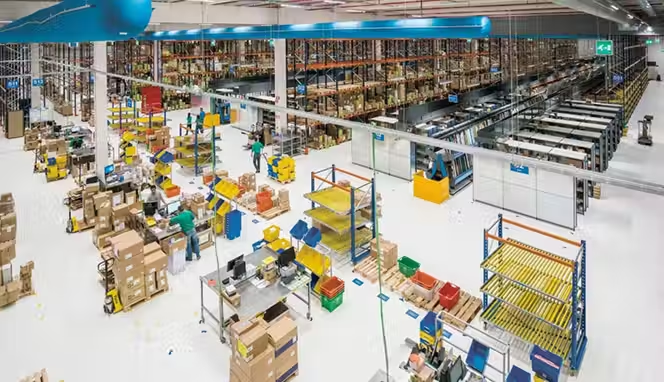
Pick and pack is a fulfillment workflow where warehouse staff (or automation) pick the correct items from storage locations and pack them securely for shipping. It sits between inventory storage and carrier handoff, and it’s one of the most quality-sensitive parts of order fulfillment.
You’ll often hear “pick, pack, and ship” as one phrase, but the “pick” and “pack” steps are where most accuracy problems happen—wrong SKU, wrong quantity, missing items, poor cushioning, incorrect label placement, or the classic “right product, wrong variant.”
Why pick and pack directly affects customer trust
Pick and pack may feel “operational,” but customers experience it as brand reliability. A well-run pick-and-pack operation leads to:
- Faster dispatch times and predictable delivery windows
- Higher order accuracy (fewer wrong or missing items)
- Lower returns and refunds caused by fulfillment mistakes
- Less product damage thanks to better packing practices
- Better reviews and repeat purchase behavior
Picking and packing are central to eCommerce fulfillment performance and customer satisfaction—because they determine whether the right items arrive safely and on time.
How the pick and pack process works step by step
Every warehouse has its own layout and tools, but the core flow usually looks like this.
Order release and pick list creation
Once an order is confirmed, the system generates a pick list (paper or digital). The pick list tells the picker which SKU to pick, how many units, and where they’re stored (aisle, bin, shelf). This pick-list-first approach is the foundation of picking and packing workflows.
Picking the items from storage locations
Pickers travel to storage locations, retrieve products, confirm they picked the correct item and quantity, and move the items to a tote, cart, or picking container. Picking is where most labor time gets spent, which is why picking method choice matters so much.
Moving picked items to packing
Picked items are delivered to a packing station (or a consolidation area first if the order requires items from multiple zones).
Packing verification and protective packaging
Packers verify the order contents, select the right box or mailer, add dunnage or cushioning, include inserts if needed, and seal the package properly.
Labeling and staging for shipping
The package gets a shipping label, carrier service selection (when applicable), and is staged in the outbound area for pickup.
Picking methods and when to use each
Choosing the right picking method is one of the highest-impact decisions you can make. The right method depends on order volume, SKU count, how often items repeat across orders, warehouse layout, and staffing.
1. Single order picking
This is the simplest approach: one picker picks one order at a time.
Best for
- Low daily order volume
- Small warehouses
- High variability across orders
Tradeoffs
- Travel time becomes expensive as volume grows
- Harder to scale without more staff
2. Batch picking
Batch picking groups multiple orders together so a picker can grab the same SKU once, then later sort items into individual orders.
Best for
- Many orders sharing the same SKUs
- Small, fast-moving catalogs
- Promotions and volume spikes
Tradeoffs
- Requires good sorting and pack verification to prevent mix-ups
- Works best with scanning and clear totes/cart organization
3. Zone picking
Zone picking assigns pickers to a specific warehouse zone. Orders move through zones until all items are collected.
Best for
- Larger warehouses
- High SKU counts
- Teams where specialization improves speed
Tradeoffs
- Requires a clean consolidation process
- Bottlenecks can appear if one zone is overloaded
4. Wave picking
Wave picking releases orders in waves (often timed to carrier cutoff times or staffing schedules). It’s useful when you need coordination across zones and shipping schedules.
Best for
- Medium to high volume warehouses
- Strict carrier pickup windows
- Multi-channel fulfillment
Tradeoffs
- More planning and system support required
- Less flexible if priorities shift constantly
Packing best practices that reduce damage and returns
Packing is not just “put it in a box.” It’s a controlled process that protects the product, communicates your brand, and prevents customer frustration.
Choose the right packaging size and material
- Use the smallest packaging that safely fits the item
- Avoid oversized boxes that increase dimensional weight costs
- Match mailers vs cartons to product fragility and shape
Standardize packing stations
A good packing station should have:
- Common box sizes within arm’s reach
- Tape, labels, and cutters positioned consistently
- Scales and dimensioning tools (if you use rate shopping)
- Clear SOPs posted at eye level
- A scanning workflow for verification when possible
Add the right protective fill
Use cushioning based on risk, not habit:
- Bubble wrap or foam for fragile goods
- Kraft paper for moderate movement control
- Air pillows for light products with space
- Dividers for multi-item orders that can scuff
Build in verification
Two proven approaches:
- Pick verification (scan at pick)
- Pack verification (scan at pack)
Even a lightweight scan step can prevent the most expensive errors (wrong item, wrong variant, wrong quantity).
Warehouse layout tips that make picking faster
Warehouse layout is a hidden profit lever. A small change in product placement can reduce walking time dramatically.
Slot fast movers closer to packing
Your top-selling SKUs should live in the easiest-to-reach locations near packing and outbound staging.
Group items that are frequently ordered together
If customers commonly buy products A + B, store them closer together. This reduces average pick path length.
Keep aisles pick-friendly
- Clear labeling (aisle, bay, shelf, bin)
- Enough space for carts to pass
- Minimize dead ends and backtracking
Use a “golden zone” for high-frequency picks
The “golden zone” is typically waist-to-shoulder height—where picking is fastest and least physically taxing.
How WMS tools improve pick and pack accuracy
If your order volume is rising, manual processes start to crack: mis-picks increase, inventory counts drift, and new hires take too long to ramp up.
A Warehouse Management System (WMS) helps by:
- Assigning pick paths
- Tracking bin locations
- Supporting batch, zone, or wave workflows
- Enabling barcode scanning verification
- Synchronizing inventory across channels
Picking and packing is a workflow that can be optimized with warehouse software to reduce costs and improve efficiency..
KPIs that tell you if pick and pack is improving
If you don’t measure it, you’ll guess—and guessing gets expensive in fulfillment.
Pick accuracy rate
What it tells you: how often the correct items and quantities were picked.
How to improve: scanning, clearer bin labeling, better slotting, better training.
Order accuracy rate
What it tells you: the order shipped with the correct contents overall.
How to improve: pack verification, standardized packing SOPs, fewer handoffs.
Lines picked per hour
What it tells you: picker productivity.
How to improve: route optimization, better layout, batch/zone picking.
Order cycle time
What it tells you: time from order release to shipment.
How to improve: wave planning, packing station readiness, better staffing.
Damage and return rate tied to fulfillment
What it tells you: whether packing protection is appropriate.
How to improve: right-sizing packaging, better dunnage rules, carrier handling feedback loops.
Common pick and pack mistakes and how to prevent them
Small issues repeat at scale. Here are the most common failure points and fixes.
Mistake: Similar SKUs stored next to each other without clear differentiation
Fix: add shelf labels, bin photos, barcode scanning, and slotting rules for variants.
Mistake: No formal verification step
Fix: scan at pick or scan at pack. Even one scan step can cut wrong-item shipments significantly.
Mistake: Packing decisions made “by instinct”
Fix: create packaging rules by product type (fragile, liquid, apparel, multi-item).
Mistake: New hires learn by shadowing only
Fix: SOP checklists + station signage + short test picks with supervision.
Mistake: Pickers waste time searching for locations
Fix: enforce location discipline, cycle counts, and bin-level tracking.
A practical pick and pack SOP checklist
Use this as a quick baseline and customize it to your operation.
Picking SOP checklist
- Confirm order priority and carrier cutoff time
- Use the pick list in the system (avoid memory picking)
- Verify SKU and quantity at the bin
- Place items in the correct tote/cart slot
- Mark exceptions immediately (out of stock, damage, wrong location)
- Deliver to packing or consolidation area
Packing SOP checklist
- Verify items against the order before sealing
- Choose packaging based on product rules (not guesswork)
- Add protective fill and secure movement
- Include inserts only if required for that order type
- Seal consistently and label on a flat surface
- Stage in the correct outbound lane by carrier/service
If you sell online, especially across multiple regions, pick-and-pack performance becomes your brand’s reputation.
For Spocket merchants, fulfillment quality matters because:
- Customers expect fast shipping and accurate orders
- Product variety and supplier locations can add complexity
- Seasonal spikes can strain manual workflows
A strong pick-and-pack system helps you keep service levels high while you focus on growth activities—whether that’s launching new products, improving conversion, or even building a side hustle that scales into something bigger (yes, even for people trying to make money online with a lean operation).
If you’re combining multiple suppliers, prioritize consistency:
- Standardize packaging expectations
- Set clear handling requirements for fragile or premium items
- Align dispatch SLAs with customer-facing delivery promises
When to use in-house pick and pack vs a 3PL
At some point, most growing brands ask: should we keep fulfillment in-house or outsource to a 3PL?
In-house makes sense when
- Order volume is manageable
- Products require customization, kitting, or strict brand presentation
- You’re optimizing margins and can run efficiently
A 3PL makes sense when
- Volume is high or highly seasonal
- You need faster delivery regions without opening new warehouses
- You want predictable fulfillment costs and SLAs
- You’re spending too much time managing warehouse labor and space
Even if you outsource, knowing pick-and-pack fundamentals helps you evaluate a partner properly and ask the right operational questions.
Final thoughts
Pick and pack is where warehouse efficiency becomes customer experience. When picking routes are optimized, verification is built in, and packing follows consistent rules, you ship faster with fewer errors—and your support tickets and returns drop without needing heroic effort.
For teams building with Spocket, think of pick and pack as your operational foundation. Get it right, and everything else—ads, product selection, customer retention—gets easier because your fulfillment is dependable.
Start your dropshipping business today
FAQs about Warehouse Pick and Pack
What is warehouse pick and pack?
Warehouse pick and pack is the fulfillment process where items are picked from storage locations and packed securely for shipping once an order is placed. It’s a critical step in eCommerce fulfillment because it directly impacts order accuracy, delivery speed, and customer satisfaction.
How does pick and pack work in eCommerce fulfillment?
In eCommerce, pick and pack starts when an order is received. A pick list is generated, items are collected from inventory, verified, packed with protective materials, labeled, and staged for carrier pickup. Efficient pick-and-pack workflows help online stores meet fast shipping expectations and reduce returns.
What are the most common pick and pack methods?
The most widely used pick and pack methods include single order picking, batch picking, zone picking, and wave picking. The best method depends on order volume, SKU variety, warehouse layout, and shipping cut-off times. Many growing warehouses combine multiple methods as they scale.
How can businesses reduce pick and pack errors?
Pick and pack errors can be reduced by using barcode scanning, clear bin labeling, standardized packing procedures, and real-time inventory tracking. Implementing a warehouse management system and proper staff training also plays a major role in improving accuracy.
Why is pick and pack important for Spocket sellers?
For Spocket sellers, pick and pack efficiency ensures faster order processing, fewer fulfillment mistakes, and a better customer experience. Since customers expect reliable delivery and accurate orders, a strong pick-and-pack process helps sellers build trust, reduce refunds, and scale operations smoothly.


Launch your dropshipping business now!
Start free trial


Related blogs

Dripshipper Reviews: Is This Coffee Dropshipping Platform Worth It?
Read this detailed Dripshipper review covering features, pros, cons, pricing, customer feedback, profitability, and better dropshipping alternatives.


Is BigBuy Legit? Honest Review for Dropshipping Businesses
Find out if BigBuy is a reliable dropshipping supplier, including its features, pros, cons, pricing concerns, reviews, and alternatives for ecommerce sellers.

What is Micromarketing and How to Use it Effectively
Learn what micromarketing is, how it works, its benefits, examples, and how ecommerce businesses can use it to target niche customers effectively.
